It's the same conversation in every coaches' group chat: one of your athletes signs up for a HYROX, asks you to get them ready, and you look around your gym and there's no sled. No SkiErg either. The rower, maybe, if you're lucky. The sandbags are two old bags of sand that weigh whatever they weigh.
The easy answer is to send them to a box that has the equipment. The expensive answer is to buy it: between a sled, a SkiErg, certified sandbags and wall balls you're looking at over five thousand dollars to serve three athletes.
There's a third option, the one most coaches who already have people on the podium use: train the stimulus, not the machine. Every HYROX station demands a specific quality, and that quality can be trained with equipment you already have. What you can't do is improvise the substitution on the day or leave it up to the athlete's judgment.
This is the complete guide: what replaces what, with what load equivalence, what gets lost in each swap, and at what point in the block you absolutely have to go find the real equipment.
The rule that governs every substitution
Before the table, the criterion. A substitution works when it preserves the three variables that make the original station hard: the movement pattern, the duration of the effort, and the dominant energy system.
If you keep all three, the transfer is high. If you lose one, the substitution is still useful but needs a complement. If you lose two, you're training something else and it's worth being honest about it.
The classic example of a bad swap: replacing the sled push with a leg press. The pattern looks similar, but the press is a 40-second set with the athlete seated, with no running component or real cardiovascular demand. You lose two of the three variables. It's not a sled push substitute: it's quad work.
The right question isn't "what looks like the sled," but "what produces burning legs and out-of-control breathing for 90 seconds while pushing."
Station by station: the swap that actually transfers
SkiErg (1000 m)
It's the hardest station to replace well, because no common machine replicates the demand on the lats and core in a vertical pulling pattern.
- Best substitute: erg rowing focused on a high pull and a low stroke rate, in blocks of 3 to 4 minutes.
- Must-have complement: vertical pulling with a band or a high cable, sets of 30 to 45 seconds with little rest, to take the lats to local fatigue.
- If there's no rower: double-wave battle ropes for 40-second rounds, plus the cable work. You lose the leg component.
- What's lost: the specific coordination and breathing rhythm of the ski. It's the station most worth trying on the real machine at least twice before competing.
Sled push (50 m)
Good news here: it's one of the easiest to approximate with cheap equipment.
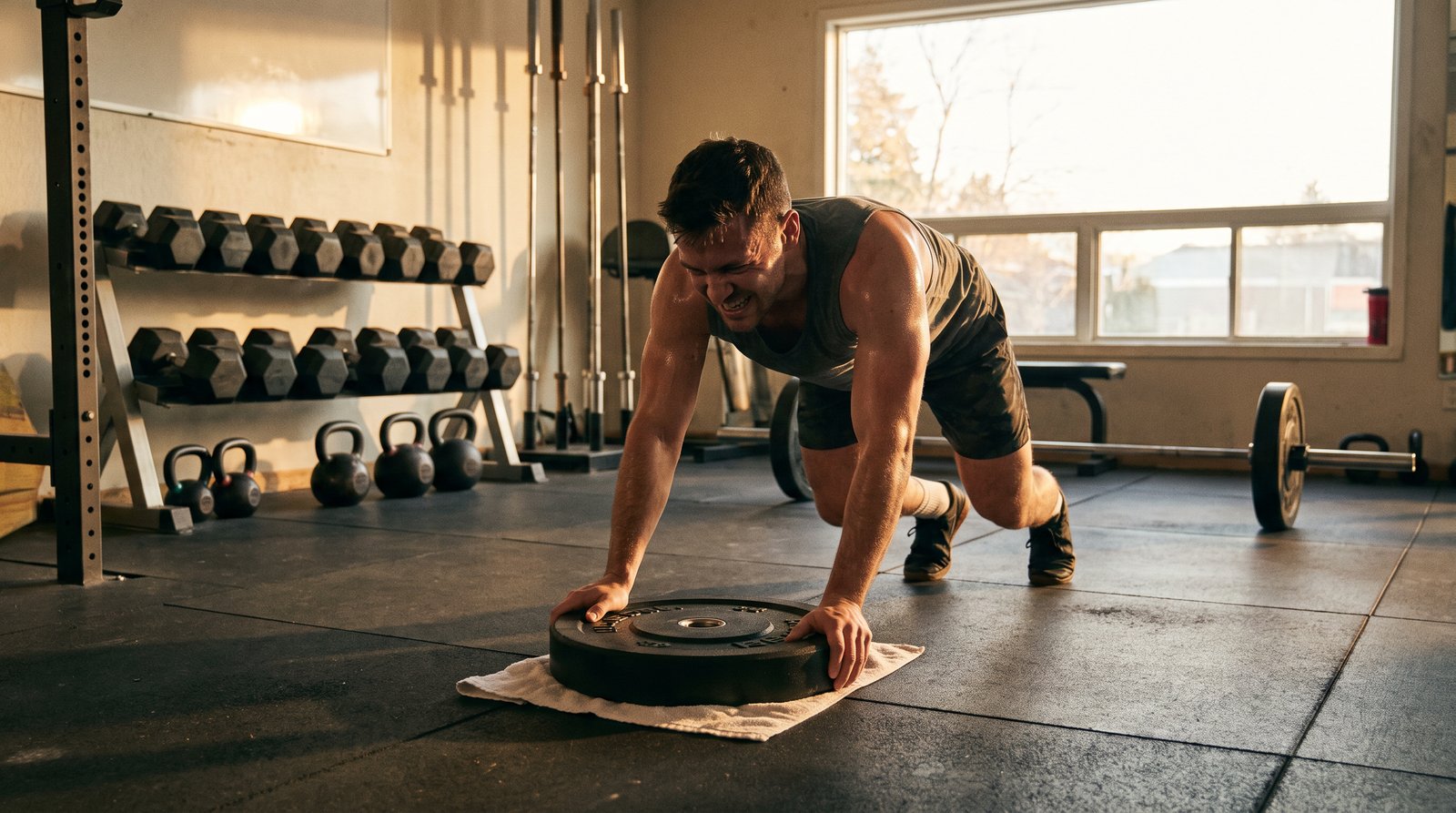
- Best substitute: weight plates stacked on a towel or a tarp, pushed with your hands resting on the top plate, on smooth floor. With 60 to 100 kg of plates you already have a real stimulus.
- Alternative: pushing a loaded cart or wheeled platform, or a short hill at a 10-15% grade in 20- to 30-second sets.
- Load equivalence: the friction of a towel on rubber flooring is much higher than that of the sled on the event floor. As a practical reference, start with half the competition weight and adjust by time: the set should last between 25 and 40 seconds.
- What's lost: not much. It's the best-transferring swap of the eight.
Sled pull (50 m)
- Best substitute: the same plates on a tarp with a rope or strap tied to them, pulled from a standing position, hand over hand, walking backward.
- Alternative: horizontal cable row with heavy load and 30-second sets, plus grip work.
- What's lost: the anchored foot position and the isometric posterior-chain work in a partially flexed position. Compensate with slow-tempo Romanian deadlifts.
Burpee broad jumps (80 m)
This one doesn't need equipment: it needs space. If your gym doesn't have 15 meters of open space, the substitution is by time, not by distance.
- Substitute: sets of burpee broad jumps done in place, or a burpee plus a jump onto a low box, controlling the number of reps per minute instead of the meters.
- How to dose it: if the athlete does the real station in 4 minutes, program 4-minute blocks at the same rep cadence. The goal is to train the sustainable rhythm, not the jump's peak power.
Row (1000 m)
If you have a rower, there's nothing to substitute. If you don't, accept that this is the point where you need to go find one.
- Reasonable patch: air bike or assault bike in 4-minute blocks, with separate barbell or dumbbell rowing work for the posterior chain.
- Rule: no athlete should go into competition without having rowed 1000 meters at target pace at least four times. If your gym has no rower, those four sessions get scheduled somewhere else and put into the plan like any other session.
Farmers carry (200 m)
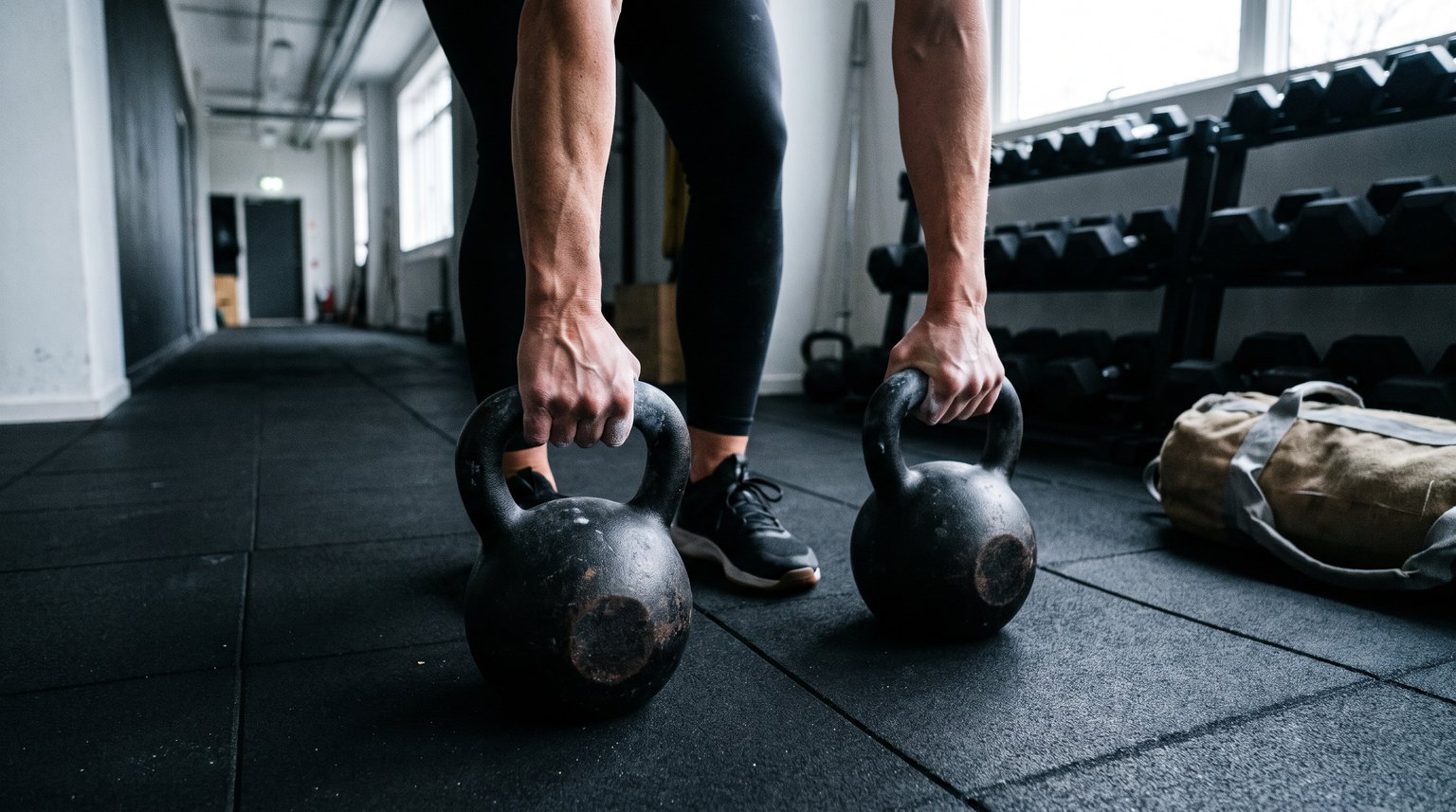
- Best substitute: kettlebells or dumbbells at the closest weight to competition, on out-and-back routes within whatever space you have.
- If the space is short: prioritize time under load over distance. Two 90-second sets without putting it down are worth more than eight short laps with a pause at every turn.
- Detail that matters: kettlebell handles are thinner than competition farmers handles. Add towel or thick-bar grip work once a week so the forearm isn't the surprise of race day.
Sandbag lunges (100 m)
- Best substitute: lunges with a barbell on the upper back or with a homemade sandbag. A well-made sandbag costs less than twenty dollars and is the best bang for your buck on the whole list.
- If you only have dumbbells: front-rack lunges with two dumbbells. It changes the core demand but keeps the pattern and the quad fatigue.
- What's lost: the instability of the bag and the compression on the shoulders. It's a real difference: dead weight on the upper back changes the breathing.
Wall balls (75 to 100 reps)
- Best substitute: thrusters with a light dumbbell or an empty barbell, at the same rep rhythm as the station.
- If you don't have a high enough wall: squat with a vertical medicine ball throw, or a thruster with a pause at the top to force full extension.
- What's lost: the visual aiming component, which is what causes no-reps in competition. This can only be trained with the ball and the wall, so at least two sessions in the final block have to use the real equipment.
The shopping list, in order of return
If you're going to invest, do it in this order. It's built by the ratio between what it costs and the stations it unlocks for you:
- Homemade sandbag. Minimal cost, it covers the lunges and adds unstable-load training for the whole year.
- Old plates and a tough tarp. They cover the sled push and sled pull, the two stations where most seconds get lost.
- A pair of heavy kettlebells. Farmers carry, grip work and a good chunk of your conditioning.
- Wall ball and a marked wall. Cheap, and it removes the risk of no-reps on the final station.
- Rower. The first expensive piece of equipment that's worth it, because it also serves all your general aerobic work.
- SkiErg. Last. It's the one you'll use least per week and the one that's easiest to patch with a cable machine.
With the first four items, which together cost less than a year of gym membership, you cover six of the eight stations with high transfer.
The two sessions that aren't negotiable
Everything above works for the general block and the early specific block. But there's a clear limit: in the last four weeks before the race, the athlete has to touch the real equipment at least twice.
Not for physical conditioning, which is already handled. For three things a substitution can't give you:
- Calibrating the effort. The real sled on the event floor behaves differently than plates on a tarp. An athlete who's never pushed one doesn't know if they'll be able to do it in one go or in segments.
- Learning the execution details. Where to grip the sled, how to pick up the sandbag, what height to release the wall ball from. These are seconds lost from not knowing them.
- Lowering anxiety. The athlete who gets to the start line having done all eight real stations competes. The one who gets there having only done substitutions competes and also discovers things, which is the worst possible combination.
Schedule those two sessions at the start of the block, not when ten days are left. A friendly box, a one-month membership at a fully equipped gym, or a mock-race day with other local coaches solves the problem at low cost.
How to write this down so it doesn't depend on you
The practical problem with working from substitutions isn't choosing them: it's keeping them up over time. Every athlete trains in a different place, with different equipment, and if the equivalence lives in your head you'll end up answering "what do I replace the sled with?" over WhatsApp four times a week.
What works is turning every substitution into part of the written plan:
- One version per scenario. The same workout with the fully-equipped-gym variant and the basic-gym variant, both loaded in advance.
- Explicit equivalence. Not "push something heavy," but the weight, the distance and the target time of the set.
- A record of which version each athlete did. Without that, comparing week to week means nothing.
- Sessions with the real equipment marked on the calendar from day one of the block.
In ATHRIX this gets solved with the exercise catalog: you create your own variants — "sled push with plates," "farmers carry with kettlebell" — with their load, distance and time parameters, and assign them according to each athlete's gym without rebuilding the whole plan. The session reaches their phone with the weight and the target written in, the athlete logs what they did, and you see in the history whether last week they pushed 80 kg or 100. The equivalence stops being a WhatsApp conversation and becomes a data point in your programming.
Conclusion
You don't need a fully equipped box to prepare athletes for HYROX. You need to know what quality each station demands and choose the replacement that preserves the pattern, the duration and the energy system.
Start with the cheap stuff: a sandbag, plates on a tarp and two kettlebells cover most of the work. Leave the rower and the SkiErg for when the volume of athletes justifies it, and patch the gap meanwhile with a cable machine and a bike.
And reserve two dates with the real equipment in the final block. That's the part that can't be substituted, and it's also the part that turns a prepared athlete into one who also shows up calm.