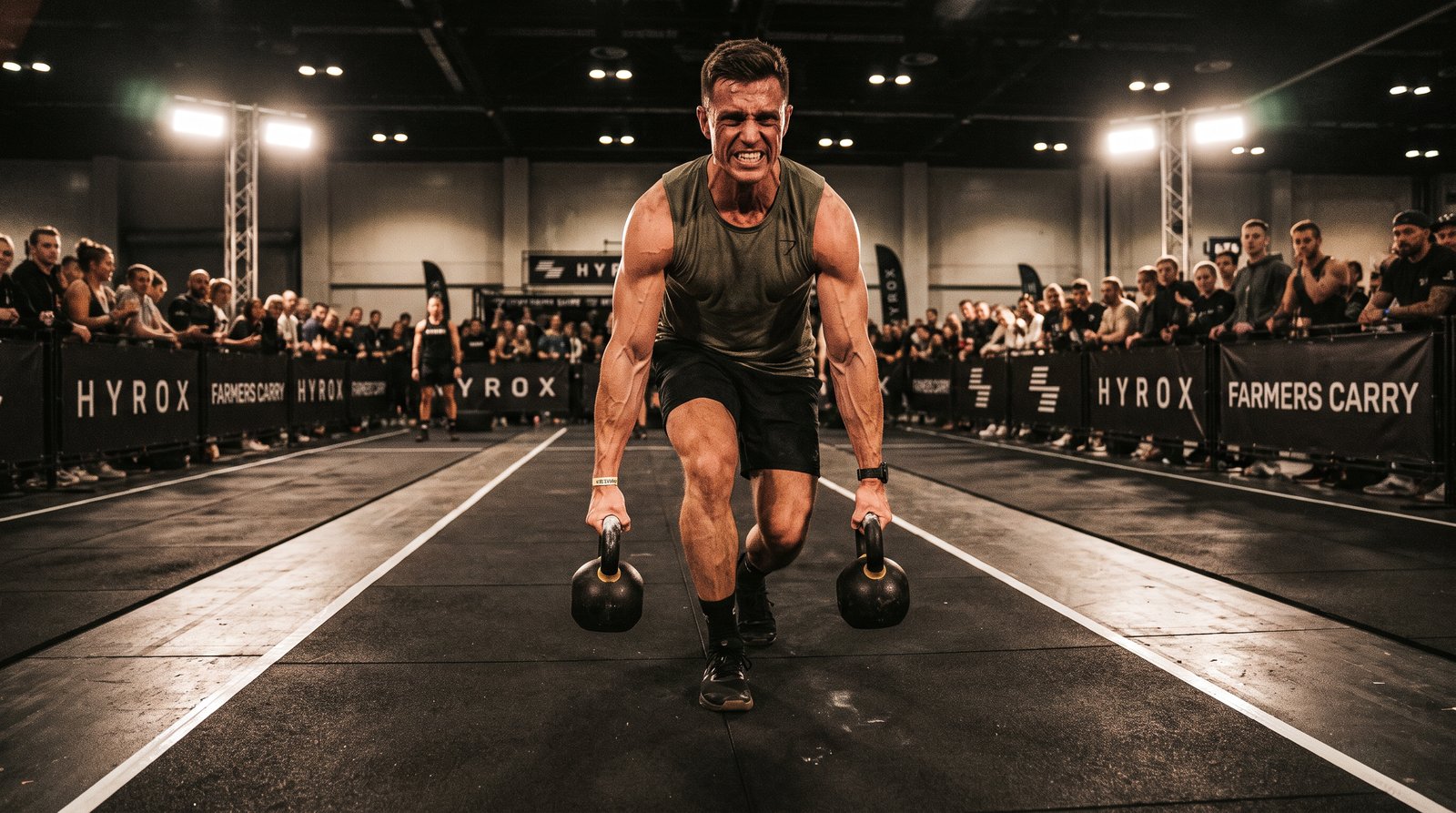
Of HYROX's eight stations, the farmers carry is the only one where your athlete can shave off almost a full minute without getting any stronger, faster, or more aerobic.
That's not an exaggeration. It's the direct consequence of how the station is built: 200 meters walking with two kettlebells. There's no complex technique, no range of motion to judge, no possible penalty. The clock measures exactly one thing: how many times they put them down.
And that's the trap. Because it looks like the easy station, almost no coach programs it. Athletes get to race day never having carried two kettlebells 200 meters straight in their life, they drop three or four times, lose forty seconds, and head out to run with fried forearms right before the two stations that decide the result. All of that is preventable with two kettlebells and a hallway.
What the station actually asks for
It's 200 meters carrying two kettlebells, one in each hand, held by the handle. In the Open division it's 2×24 kg for men and 2×16 kg for women; in Pro, 2×32 and 2×24. The lane is 50 meters long, so your athlete will do four lengths with three turns in between.
Athletes can set the kettlebells down on the floor as many times as they want: there's no penalty for dropping them. That's exactly the problem. The absence of a formal penalty makes the athlete improvise on the fly, and every improvisation costs between eight and twelve seconds: stopping, setting down, shaking out the hands, bending down, re-gripping, starting from zero again.
Benchmark times frame the conversation better than any feeling. An elite athlete clears the station around 1:10 to 1:25, almost jogging and without dropping. A well-prepared amateur walks hard and finishes in 1:45 to 2:10, with zero or one pause. An amateur without specific preparation goes to 2:45 or 3:00, and practically all of that excess is drops.
The difference between a good and a bad farmers carry is almost never grip strength. It's how many times the athlete decided to drop, and that decision is trainable.
The detail that changes everything: it comes after the row
This is the point that separates an analysis of the station from an analysis of the race. The farmers carry is station 6. Station 5 is 1000 meters of rowing.
Your athlete doesn't reach the lane with fresh hands: they get there after 4 to 5 minutes pulling a handle, with finger flexors already congested, and with barely a kilometer of running in between to recover them. Running doesn't rest the grip enough: it lowers the congestion a bit, nothing more.
That's why grip tests done fresh lie. An athlete can hang ninety seconds from a bar on a Tuesday at 10 a.m. and drop the kettlebells at meter 60 on race day. Those are different things: one measures grip strength, the other measures grip endurance under specific prior fatigue.
Practical consequence for your programming: if you're going to train the farmers carry just once every two weeks, make it always after rowing. Carrying kettlebells while fresh at the end of a strength session is a different exercise from the one your athlete will have to execute on race day.
The five mistakes you see in the lane
1. Gripping the handle with an open hand
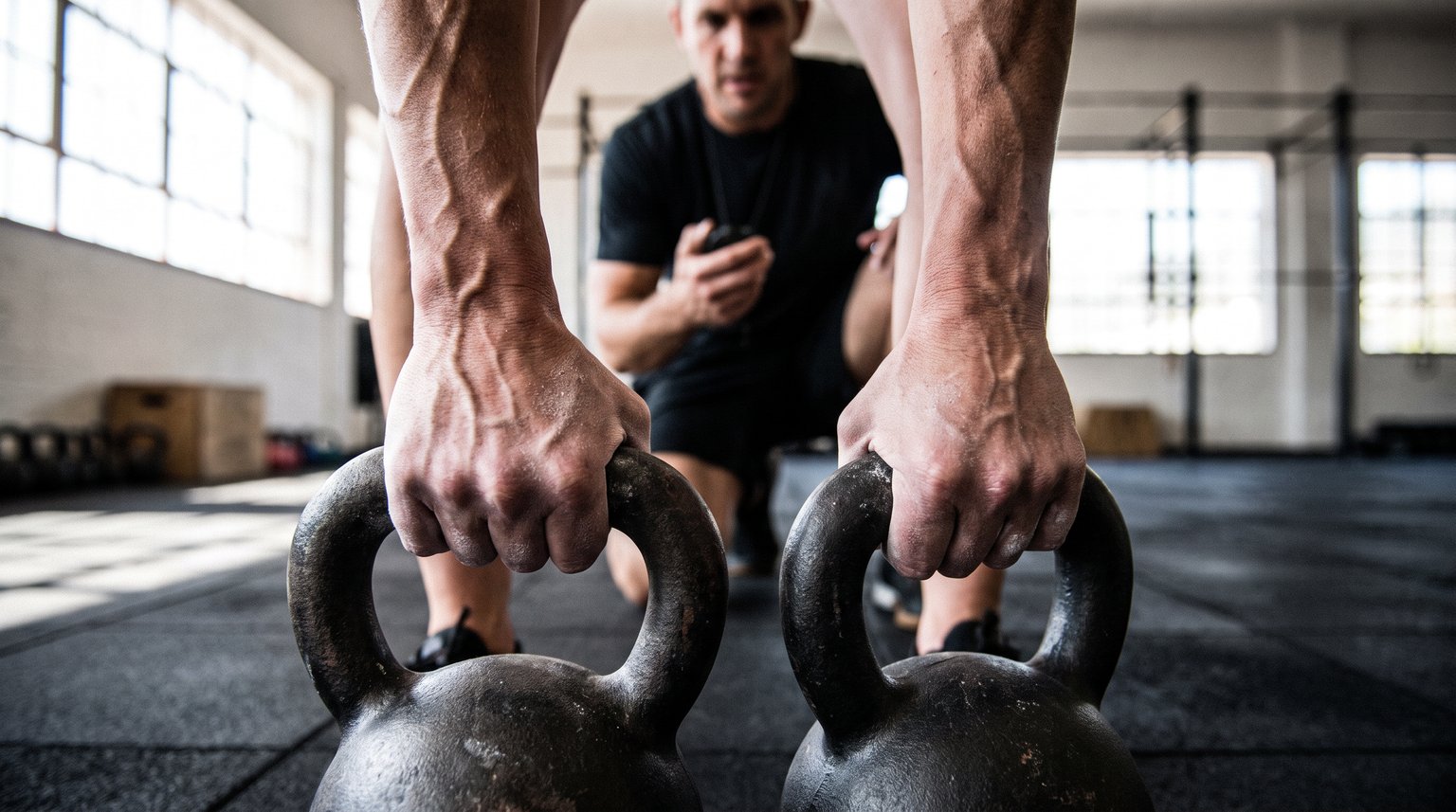
The most common and most costly mistake. Most people grip the kettlebell with four fingers and leave the thumb to the side, resting on the index finger. That open grip puts all the work on the finger flexors, and it gives out fast.
The fix is closing the circle: thumb over the fingers, wrapping the handle. It takes two sessions to get used to and after that it costs nothing. And the kettlebell needs to sit at the base of the fingers, not the middle of the palm: resting in the center of the palm, the skin folds, burns, and the athlete drops from pain long before the muscle actually fatigues.
2. Walking with slumped shoulders
When the athlete lets the weight pull their shoulders down and forward, the load shifts to hanging off the grip and the shoulder capsule. It's a passive position that feels comfortable for ten seconds and then starts to choke the athlete.
The cue is shoulders back and down, chest open, kettlebells against the thigh. If the bells drift forward, the athlete is giving in. With the load properly resting on the upper back, the grip only has to hold on, not stabilize.
3. The turns
Three turns per station and almost no one practices them. The typical mistake is stopping completely, turning in place with the kettlebells swinging, and starting again: two or three seconds per turn, and the swinging forces a re-grip on top of that.
The correct turn is wide and without stopping, tracing an arc about a meter and a half wide instead of a pivot. You lose a meter of distance and save two seconds and a re-grip. It's the cheapest detail to fix in the whole station.
4. Holding the breath
Under load, the athlete tends to clench everything, including their breathing. They reach meter 100 with their heart rate spiking and drop from lack of air, not grip.
Anchor the breathing to the step: inhale for two steps, exhale for two steps, with the torso firm but without locking up. It's the same cue you use for compromised running, and it transfers directly.
5. Going out too fast
The first 50 meters feel light and the athlete jogs. At meter 80 the congestion hits all at once, and the first pause comes before the turn at 100. After that first pause, the rest of the station turns into a cycle of short segments.
The right pace is the fastest they can sustain for 200 meters without dropping, not the fastest they can sustain for 50. For most amateurs, that's a very brisk walk, not a jog.
The decision that has to be made before the race
Here's the biggest contribution you can make as a coach, and it has nothing to do with training: it's a decision made in the pre-race talk.
The question isn't "are you going to drop?" It's "if you have to drop, where?" An athlete who steps into the lane with that answer already decided behaves completely differently from one who's improvising.
- If in training they do the 200 meters without dropping: the plan is zero drops. Tell them exactly that. The cue is "the kettlebells don't touch the floor until the end."
- If in training they drop once or twice: the plan is a single planned drop, at the turn at meter 100, exactly three seconds. Set down, shake out, pick up. Not five seconds, not "until it feels good": three, counted.
- If they've never completed even 100 meters straight: the plan is two drops at the turns (meter 50 and meter 150, or 100 and 150). And write it down as the limiter to attack in the next block.
The principle behind this: a planned drop at a turn is almost free, because it coincides with a moment where the athlete was going to slow down anyway. An improvised drop in the middle of a length costs twice as much, because it includes braking and re-accelerating in a straight line.
Four improvised drops are forty seconds. One planned drop is eight. No strength block makes up for that difference: a decision made the day before does.
How to program it through the week
The good news is it's the cheapest station of the whole course to train: two kettlebells and twenty meters of space. The bad news is almost no one programs it because it doesn't feel productive.
Two weekly exposures are enough, and neither needs to be long.
- Heavy, short carries, once a week. 20 to 30 meters with 15 to 25% more than race weight, 4 to 6 sets, full rest. This raises the strength ceiling and makes race weight feel light. It goes at the end of the strength session, never before a pulling block.
- Volume at race weight, once a week. 3 to 4 carries of 100 to 200 meters, 90 seconds of rest. Here the goal isn't the weight: it's finishing without dropping. If they drop, the next carry gets shorter.
- Specific work with prior fatigue, every two weeks. The format that transfers the most: 500 meters of rowing + 200 meters of farmers carry + 400 meters of running, 3 rounds. It's the real sequence of the race, and the only place where your athlete will discover their actual sustainable pace.
- Accessory grip work, twice a week, 5 minutes. Dead hangs from a bar (accumulate 2 to 3 minutes in sets), heavy bar holds, or single-arm carries. It's what responds fastest in amateur athletes, because almost none of them have ever trained it.
A programming warning: grip recovers slowly. Don't schedule heavy carries the day before a long row, pull-up, or sled pull session. In a week with all three, grip becomes the silent bottleneck that ruins all three sessions.
The test that gives you the diagnosis
You need two kettlebells at race weight, a rower, and 200 meters marked out. Ten minutes total.
- Carry A, fresh: 200 meters of farmers carry at race weight. Record time and number of drops.
- 5-minute rest.
- 1000 meters of rowing at the target race pace.
- Carry B, fatigued: 60 seconds after finishing the row, another 200 meters of carry. Record time, drops, and at which meter the first one happened.
From there you get three numbers that are worth more than any feeling:
- Drops in carry A. If they drop fresh, the limiter is pure grip strength, and the work starts with heavy carries and dead hangs.
- Difference in drops between A and B. Zero in A and three in B is the most common profile: enough strength, not enough endurance under fatigue. That athlete needs the specific row+carry block, not more weight.
- The meter mark of the first drop in B. It's the number that best measures progress. Going from meter 60 to meter 140 in six weeks is a huge improvement, and it's perfectly visible to the athlete.
Repeat it every six weeks. It's a test that's cheap to run, doesn't leave significant residual fatigue, and gives a diagnosis the athlete can't argue with.
What to tell them on race day
- Lift with the hips, not the back. The kettlebells are picked up with a hip hinge and the chest high. It's the same pattern every time they pick them back up.
- Thumb wrapped, handle at the base of the fingers. Ten seconds spent setting the grip at the start are worth more than any correction afterward.
- The drop plan is the plan. Zero, one, or two, defined in advance and always at a turn. It doesn't get renegotiated in the lane.
- Wide turns, without braking. An arc, not a pivot.
- Breathe with the step. Two steps in, two steps out.
- Shake out the hands on the next run. Loose arms and open fingers during the kilometer that follows bring back a lot more grip than the athlete thinks, and the sandbag lunges that come after also demand grip.
Why this station sells you as a coach
The farmers carry is probably the best selling point on the whole course, for a simple reason: it's the station with the best ratio between how little it costs to train and how much it improves.
- The improvement is fast and big. An athlete who goes from four drops to one saves thirty seconds in six weeks. No running block gives them thirty seconds in six weeks.
- It's unambiguously measurable. Drops and the meter mark of the first drop. No room for interpretation, no feeling, no debate.
- It doesn't need expensive equipment. Two kettlebells and a hallway. It works in a box, in a park, or in an online athlete's garage.
- It shows race judgment, not just training judgment. When you tell an athlete exactly at which meter they're going to drop and why, you're showing them that you thought through their whole race. That's something a plan downloaded from the internet never does.
What keeps all of this going is tracking. In ATHRIX you can set up the test as a workout with its blocks, record time, drops, and the meter mark of the first drop on every repetition of the test, and track that curve throughout the block. When you show the athlete that their first drop moved from meter 60 to meter 140 and that's thirty fewer seconds on race day, the conversation about renewing the plan happens on its own.
Conclusion
The farmers carry isn't the hardest station in HYROX, and that's exactly why it gives away the most time. Nobody trains it because it looks like walking, and everybody suffers through it because it comes right after the row.
Put in heavy, short carries once a week, volume at race weight on another day, and a row+carry session every two weeks. Always test under fatigue, never fresh. And decide with your athlete, before they step into the lane, how many times they're going to drop and exactly where.
It's the cheapest intervention on the whole course, and one of those that give back the most seconds.