
A new athlete walks in. They tell you they do "a bit of everything," that they want to drop their times, that they hurt their knee a couple of years ago but it's fine now. You open the spreadsheet and write the first session. Based on what? On what they told you in five minutes standing at the door, and on what you assume from their age and appearance. That's not programming: that's betting with someone else's body and hoping it works out.
The alternative costs between 60 and 75 minutes and is called the initial test battery. It's a structured session, with a written protocol, where you measure what you're later going to try to improve. It's not a methodological whim or a ritual to look more serious: it's the only way to know whether the block you built actually worked. And along the way, it's the moment when the athlete understands, with their own numbers, why they're going to pay you every month.
Programming without data is guessing with good intentions
Every coach has an eye for this. The eye helps, but it has two problems. The first is that you can't compare it against itself three months later: your memory of how the athlete squatted in March is contaminated by everything you've seen since. The second is that it can't be shown. "You're much better" is an opinion; "you went from 8 strict pull-ups to 13 under the same protocol" is a fact.
Without a baseline, three things happen, all bad. You program by default, applying the same template you gave the last athlete. You correct late, because you only notice the load was excessive once the discomfort shows up. And you renegotiate continuity every month based on the athlete's perception, which is volatile: if they slept badly for two weeks, they feel like they made no progress at all, and you have nothing to counter that with except enthusiasm.
If you don't measure at the start, you're not training an athlete: you're testing ideas on them and hoping none of them turn out costly.
What to assess, and in what order
The order isn't decorative. It goes from least to most invasive, and from least to most fatiguing, so that each test doesn't contaminate the next. First what doesn't tire them, then what tires a little, and at the end, what wipes them out.
1. Interview and history (10-15 minutes)
This is the cheapest test and the one that changes the most decisions. Ask and write down:
- Injury history: what, when, whether there was a professional diagnosis, whether there's current pain or limitation.
- Health history: known conditions, medication, recent pregnancies, surgeries. Here you don't form opinions: you record.
- Prior training load: how many years, how many sessions per week over the last three months, with which modalities.
- Life context: typical sleep hours, work shifts, travel, reported stress. This determines how much volume they can tolerate, more than their level does.
- Goal with a date: not "feel better," but "run the October 10K in under 50 minutes."
- Real availability: days, times, and the equipment they actually have access to.
One clarification worth saying out loud and putting in writing: you don't diagnose. If persistent pain, nighttime pain, unexplained loss of strength, dizziness, chest pain, numbness, or any cardiovascular or metabolic history without medical control comes up, the battery stops and the athlete goes to a health professional before continuing. Referring someone out doesn't make you look less capable: it positions you as someone who knows where their own scope ends.
2. Mobility and basic pattern screening (10 minutes)
You're gathering information to program with, not a clinical verdict. A movement screen isn't a diagnosis and doesn't predict injuries on its own: it tells you which exercises you can load today and which ones need to be built up first.
- Unloaded deep squat: depth reached, torso position, heels, knee valgus.
- Hip hinge: whether they can flex from the hip while keeping a neutral spine, using a reference stick.
- Shoulder and thoracic mobility: ability to raise the arms overhead without compensating with the lower back.
- Ankle: knee-to-wall distance, measured in centimeters, each side separately.
- Single-leg support: single-leg squat or step-down, to look for asymmetries and control.
Record on a simple scale (for example 0 to 3), and always left and right side separately. Asymmetries are half the value of this block.
3. Relative strength (15-20 minutes)
With a new athlete, chasing a real 1RM is unnecessary and risky. Use estimates and bodyweight tests:
- Submaximal sets: 3 to 5 reps with flawless technique in one push pattern and one pull pattern, estimating from there.
- Bodyweight: maximum strict pull-ups, push-ups with controlled tempo, Bulgarian split squat with moderate load.
- Isometrics: front and side plank with a cutoff criterion based on loss of position, not on suffering.
- Cutoff criterion: define in advance what ends the set (loss of range, speed, or technique). Without that, the test isn't comparable.

4. Aerobic capacity (10-12 minutes)
Pick a single test and stick with it over time. Practical options depending on the equipment you have:
- Fixed-time test: 12 minutes of running or 2000 meters on the rower, with distance or time as the result.
- Submaximal test: a step test with heart-rate monitoring, useful for deconditioned athletes or those with a medical history.
- Progressive field test: with cones and a standardized audio track, if you work with groups.
Always record the conditions: surface, weather, time of day, footwear, and whether they used a heart-rate monitor. The same athlete can vary quite a bit between a midday test in the heat and the same test in the morning; in practice, that difference is enough to make you believe in an improvement that never happened.
5. Localized muscular endurance (8-10 minutes)
Here you measure how much they can sustain, not how much they can lift. Sets to technical failure in two or three exercises that you're later going to use in the program: inverted row, air squat at a set cadence, hip thrust with fixed load, farmer carry for distance. The key is fixing the load or cadence now, so you can repeat it exactly in three months.
6. Discipline-specific test (10 minutes)
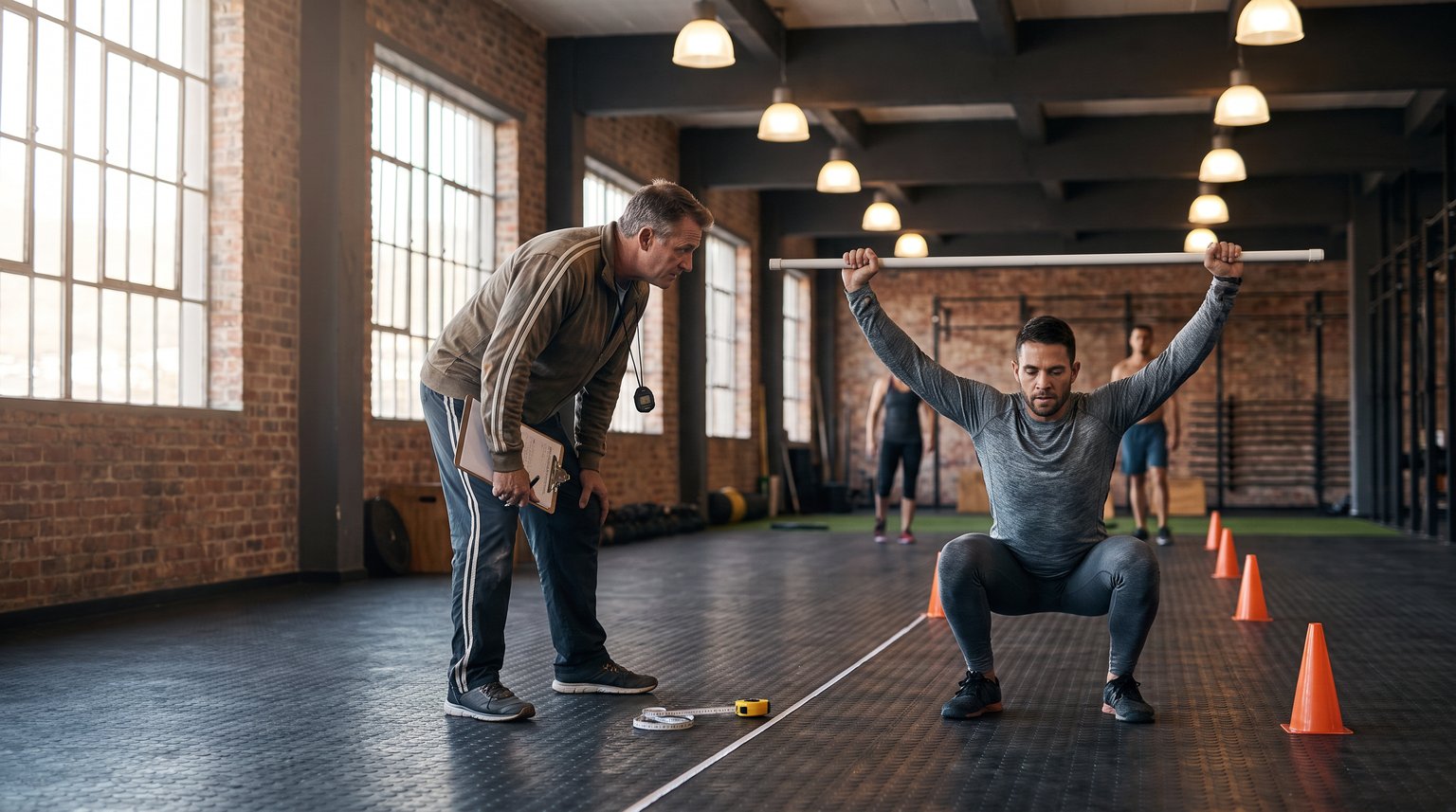
The last block is the one that gives meaning to everything before it, in the athlete's eyes. If they run, a sustained-pace test. If they do strength sports, a complex with load and technique. If they compete in functional fitness, a short, standardized sequence of two or three movements. If they play a team sport, a change-of-direction test. Just one, short, and always the same one.
How to fit it into 60-75 minutes without wiping out the athlete
The classic mistake is wanting to measure everything on day one. Rules that work:
- Maximum two fatiguing tests: one strength test and one aerobic test. The rest is observation and recording.
- Fixed order: interview, screening, strength, specific, aerobic. Whatever leaves the most residue goes last.
- Rests written into the protocol: if you set 3 minutes between attempts, it's 3 minutes every time, including at the retest.
- Timed warm-up: the warm-up is part of the test and has to be identical every time.
- Split it into two if needed: with very deconditioned athletes or those with a medical history, two 40-minute sessions pay off more than one 80-minute session.
- Everything written down on the spot: no "I'll log it later." What doesn't get recorded there gets lost or made up.
Repeatable or it's useless: the protocol rules
A test you can't repeat under identical conditions is an expensive anecdote. Before measuring for the first time, write the full protocol, with an almost annoying level of detail: exact warm-up, exercise order, loads or cadences, cutoff criteria, number of attempts, rests, specific equipment (that bar, that machine, that rower), and even the exact words you're going to use to give the command. Encouragement changes results: if you shouted on the first day and didn't on the second, you're measuring your own enthusiasm, not their progress.
Add three more conditions: same time of day, similar rest and nutrition status (ask, and write down how they arrived), and at least 48 hours without intense prior training. Choose few tests and defend them: six measures you can repeat exactly are worth infinitely more than twenty you'll never be able to replicate.
The report: handing back the results in a way that's understood
A PDF with fifteen variables and no criteria is noise. A good report has four parts and fits on two pages:
- Where you are today: the raw numbers with their unit and the date, no adjectives.
- What they mean: translated into human language, referencing their own goal, not some dubious population average.
- What we're going to attack first: two or three priorities, with the explicit reason why those and not others.
- When we measure again: a concrete date already scheduled, not "later on."
On retest frequency: strength and localized endurance markers usually show interpretable changes every 8 to 12 weeks; mobility and patterns can be reviewed sooner, every 4 to 6 weeks, because they respond fast and cost no fatigue; it's best to repeat the aerobic test at the end of each major block. Retesting every two weeks just generates noise, anxiety, and lost sessions.
How this sets you apart, and how you sell it
Think about what the competition offers that athlete who's evaluating you right now: a routine and good vibes. You're offering a performance diagnosis, a justified plan, and a date to verify whether it worked. It's a different category of service, and it's perceived immediately.
Sell it in two formats. First, as a standalone entry product: an initial assessment with a report, at an accessible price, with no obligation to sign up for the month. It's a low barrier to entry, puts you face to face with someone who has already paid you something, and filters out the merely curious. A good share of those assessments end up converting into a monthly plan, simply because the report makes it obvious what there is to work on. Second, as the first session included in your package, which justifies a higher price than a generic routine. And in both cases, you're left with the hardest commercial asset to get: a "before," with numbers and a date, against which you're going to compare everything that comes after — including your testimonial for the next client.
The assessment also gives you an honest retention argument. When an athlete hesitates at the three-month mark, you don't argue about feelings: you open the retest, show them the five variables that moved and the two that didn't, and explain what the next block does about those two.
That's exactly where a platform saves you the dirty work. In ATHRIX you can leave the protocol loaded as a reusable session, so you can assign the same one to every new athlete without relying on your memory; log each result as a personal record with its date, unit, and conditions; save the screening with notes per side; and attach the video of the pattern you want to compare later on. When the retest comes around, you don't build anything: you assign the same session, and that record's history is right there, with the progression visible to you and to the athlete from their own app. That screen, with the three-month curve, is the easiest renewal conversation you're going to have.
Conclusion
The initial test battery isn't bureaucracy before training: it's the part of training that makes everything else verifiable. With 60 to 75 well-structured minutes, you have a history, a mobility map, a strength reference, an aerobic-capacity reference, an endurance reference, and a discipline-specific one. With that, the first session you write stops being a template and becomes an answer to something you measured.
Start simple. Pick six tests you can repeat with the equipment you already have, write the protocol down to the last detail, and use it with the next three athletes who come in. In three months you'll have what you don't have today: evidence that your work works, a report the athlete understands, and an entry product you can sell on its own. All of that came from writing down carefully, once, what most people prefer to assume.