
Your athlete sets the kettlebells down twelve meters short of the farmers carry line. Their legs didn't give out, their lungs didn't give out: their hands just opened. They pick them back up, walk the last few meters and lose twenty-two seconds that didn't exist on paper.
Afterward, in the debrief, they'll tell you their "forearms got tired." And you'll look at the plan and won't find a single session, in a sixteen-week block, where grip was the goal of anything.
It's the most common blind spot in HYROX programming. Everyone programs running, everyone programs the sled, many program wall balls. Almost nobody programs for the hands. And the hands show up in three of the eight stations.
Where the race takes its toll on grip
Grip isn't a quality you test in one isolated station. It's a resource you spend throughout the whole race, and it runs out right when you need it most.
- Sled pull: repeated pulling on a rope, with the hands as the only point of contact with the load. It's the station that burns the forearms most, and it comes midway through the race, with everything still ahead.
- Farmers carry: pure isometric grip, with the load pulling downward while the athlete walks. No technique compensates for a hand that can't hold on.
- Wall balls: they come last, when the forearm is already beaten up. The failure is almost never the legs: it's the ball slipping on the catch, so every rep costs a readjustment.
And there's a fourth, invisible cost: the sandbag lunge and the burpee broad jump don't demand grip, but they come in between and give the forearm no real recovery. The athlete thinks they're resting their hands when they're really just running with their heart rate up.
Grip in HYROX doesn't fail from a lack of maximum strength. It fails from a lack of endurance under accumulated fatigue. Those are two different qualities, and they're trained differently: that's why the athlete who deadlifts 180 kilos still drops the kettlebells 170 meters in.
The three grip types the race demands
If you're going to program grip, it helps to know which kind. HYROX asks for three types, and training only one leaves the other two uncovered.
Support grip (isometric)
Holding a load that pulls downward, with no movement. It's the farmers carry grip. You train it with time under tension: bar hangs, loaded carries, pinch-holding plates.
Pulling grip (dynamic)
Closing the hand around something that moves and pulls. It's the sled pull grip, and the rope grip too. You train it with rope rows, ring rows, thick-grip pulldowns and, above all, the sled pull itself.
Wide contact grip
The least obvious one: catching and stabilizing a large object with an open hand. It's the grip for wall balls and the sandbag. It isn't fist strength; it's the ability of the fingers and wrist to stabilize without clamping down. You train it with the ball and the sandbag, not with a grip trainer.

How to measure it: three ten-minute tests
You can't program what you don't measure, and for grip you don't need a dynamometer. With three tests that fit at the end of any ordinary session, you get a full profile.
- Support test: bar hang with a pronated grip, no swinging, until they let go. A reasonable reference value for a HYROX athlete is 60 to 90 seconds when fresh. Below 45, you have a clear limiter.
- Specific load test: farmers carry at their category's competition weight, until they let go. Record meters, not time. If they can't reach 200 continuous meters when fresh, they won't be able to do the race's 200 meters after five stations.
- Endurance-under-fatigue test: the one that really matters. Repeat test 1 immediately after a hard block (for example 500 m of rowing at race pace + 20 burpees). The percentage drop compared to the fresh value is your number.
That drop is the diagnosis:
- Less than 25%: grip isn't their limiter. Program it for maintenance and put your focus elsewhere.
- Between 25% and 45%: the normal range. With two well-placed weekly stimuli, you'll see improvement in six to eight weeks.
- More than 45%: you've found the bottleneck in their race. Everything you invest here will pay off in the sled pull and the wall balls.
Repeat the three tests every six weeks, in the same order and with the same prior fatigue. Without that consistency, the number can't be compared to anything.
How to program it without adding sessions
Nobody has a free session to dedicate to hands, and you don't need one either. Grip is programmed as a parasite: hitched onto work you're already doing.
- Change the implement, not the session. Rope rows instead of handles, dumbbells instead of a barbell on rows, thick grip on pulldowns. Same volume, same time, free grip stimulus.
- End strength sessions with support work. Three sets of bar hangs or farmers carry at the end, when the forearm is already tired. Two minutes of session time, placed exactly where they mirror the race.
- Density, not intensity. For grip endurance, holding 60% for a long time helps more than 90% for a short time. Long sets, moderate loads, short rests.
- Specificity at the end of the block. In the last six weeks, farmers carry and sled pull at the exact competition weight, always preceded by running. Never fresh.
Two weekly stimuli are enough. A third rarely adds anything and starts interfering with upper-body recovery, which also has to perform in burpees and wall balls.
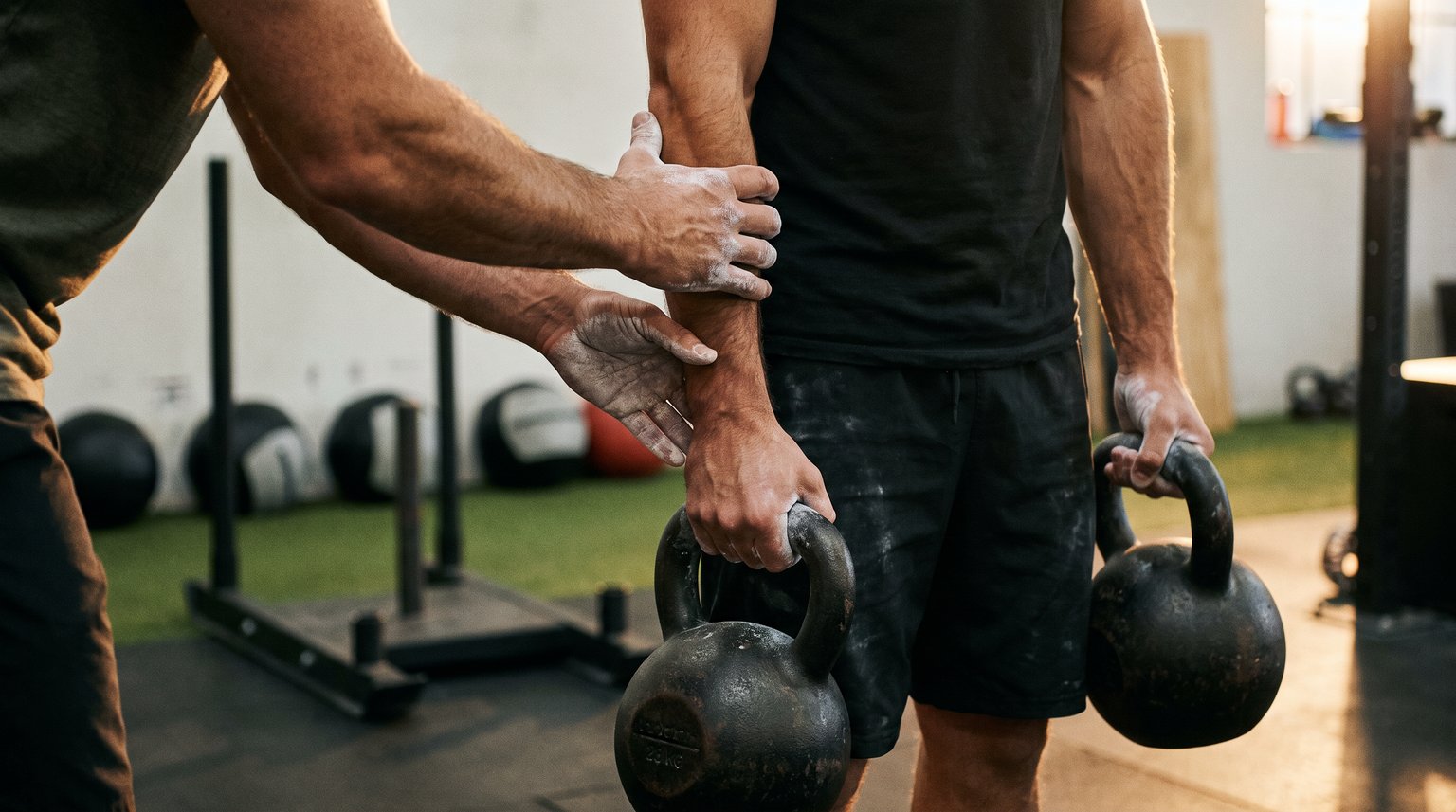
Eight-week progression
A structure that works for the athlete who showed a high drop on test 3:
- Weeks 1 and 2 — base: hangs totaling 3 minutes per session (sets of 30 to 45 seconds) and farmers carries of 4 x 40 meters with a comfortable load. Goal: tolerance, not failure.
- Weeks 3 to 5 — load: weighted hangs in sets of 20 to 30 seconds, farmers carries of 4 x 60 meters at competition weight and technique-focused sled pulls twice a week. This is where the biggest jump shows up.
- Weeks 6 and 7 — specific: farmers carry always after running, sled pull at race pace, wall balls with a pre-fatigued forearm. The goal is no longer the quality itself, it's transfer.
- Week 8 — deload and retest: half the volume and a repeat of the three tests. If the drop on test 3 shrank by ten points, that improvement is worth twenty to forty seconds of race time.
The four mistakes you see most
- Training only maximum fist strength. Hand grippers are fun and transfer little. HYROX doesn't ask you to close hard once, it asks you not to open your hand for minutes at a time.
- Using straps on everything. Straps have a place in heavy posterior-chain strength work, where grip shouldn't be the limiter. If your athlete also uses them on rows and loaded carries, you're taking away exactly the stimulus they need.
- Always testing grip fresh. An athlete can hang for ninety seconds at the start and forty after a row. That second number is the one they'll have during the race, and it's the only one you should be watching.
- Ignoring the state of the hands. Calluses, rips and sweaty hands decide races. Take hand care as seriously as footwear, and have the athlete rehearse with chalk or without it depending on what they'll have available at their event.
What to tell them on race day
Three concrete instructions, the kind that survive a high heart rate:
- Farmers carry: a single planned pause, at the midpoint, of three to five seconds. Planned always beats improvised, because the improvised pause comes once the hand has already opened, and it costs twice as much to grip again.
- Sled pull: alternate which hand leads each pull and keep the arms long, letting the hips do the pulling. The classic mistake is pulling with the elbow, which burns forearm without moving the sled any faster.
- Wall balls: catch with open, low hands, without squeezing. Every rep where the athlete squeezes too hard is forearm they won't have for rep 70.
Why this sets you apart as a coach
Grip is a perfect topic for showing professional judgment, for a simple reason: the athlete already felt the problem but doesn't know how to name it. When you explain that what happened to them 170 meters in has a name, a test and an eight-week plan, you stop being someone who sends them workouts and become someone who reads their race.
- It's a finding, not a promise. Test 3 gives them their own number, measured in your gym, that no influencer can give them. That alone justifies the price of your initial assessment.
- It's cheap to implement. You don't need new equipment: a bar to hang from, kettlebells, and the rope you already have.
- It's easy to show. "You went from dropping at 38 seconds to 61 under fatigue" is the kind of progress that's understood without explanation, and that the athlete will share without being asked.
For that to work, you need an organized history. In ATHRIX you can log the three tests as workouts with their own blocks, keep each retest's seconds and meters on record, and see the athlete's progress across the block without relying on your memory or a note on your phone. When it's time to sell the next block, you're not arguing from feelings: you're showing the curve.
Conclusion
Grip is the easiest quality to improve and the easiest one to forget. It doesn't ask for new sessions, it doesn't ask for new equipment, and it doesn't ask for extra recovery time: it just asks for someone to measure it and put it in the plan.
Measure the hang fresh and under fatigue, calculate the drop, add two weekly stimuli hitched onto work you already do, get specific in the last six weeks, and retest. It's half an hour of decisions on your part. In exchange, your athlete stops setting the kettlebells down twelve meters from the finish, and knows exactly who to thank for it.